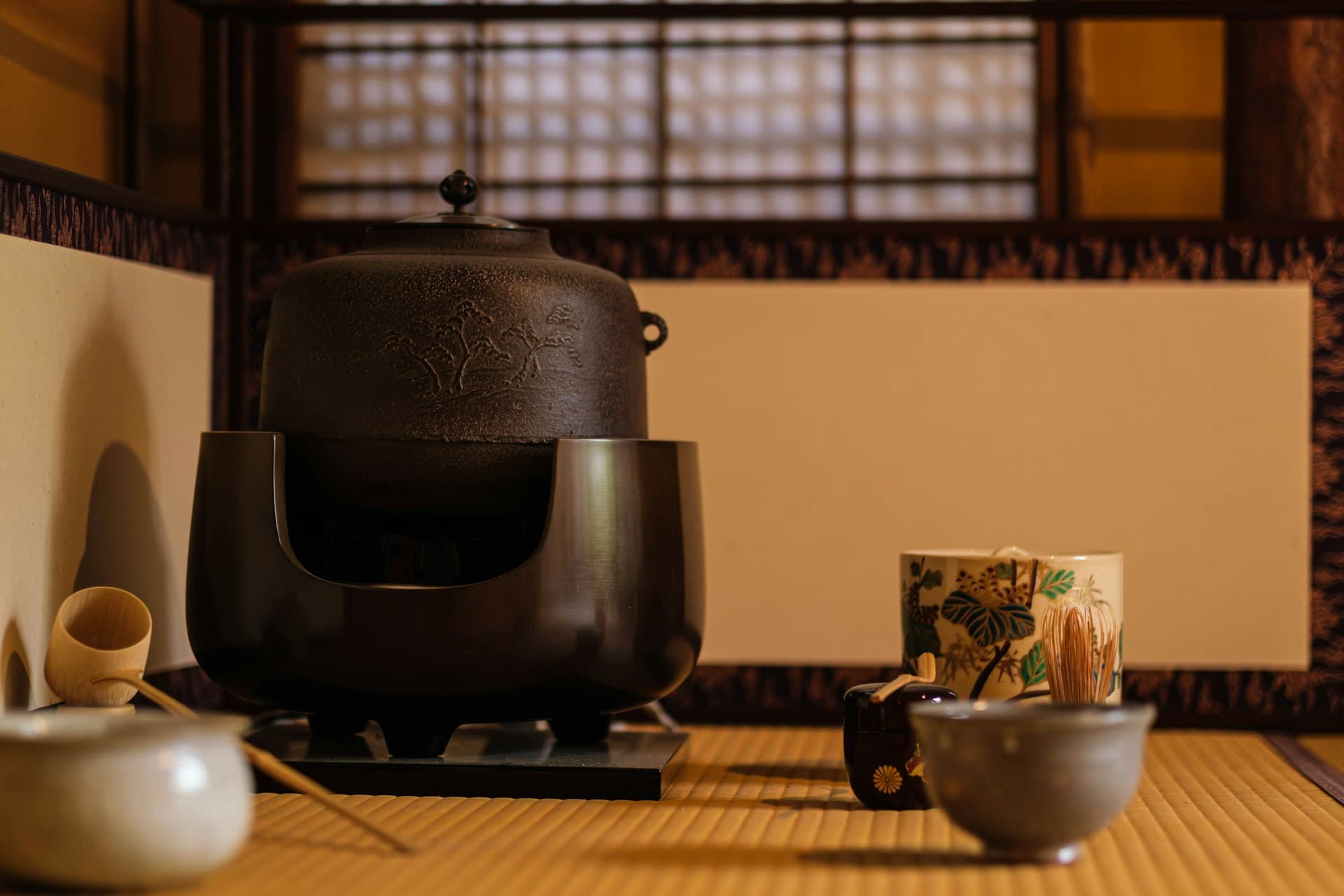
 Photo by Fumiaki Hayashi on Unsplash
Tea Houses of Kyoto: Where Tradition Meets Modernity
Kyoto's tea house culture — spaces centered on matcha and wagashi.
What "tea houses" mean in Kyoto
In Kyoto, spaces built around matcha (powdered green tea) and wagashi (traditional Japanese confections) carry their own names — saryō and sabō, often translated as "tea house" or "tea room." These are not the formal tea-ceremony rooms found in temples; they are everyday spaces where visitors sit down with a parfait or a bowl of warabi mochi.
This piece curates four of them from four corners of Kyoto, each with a distinct character — from a flagship parfait counter in Gion to a townhouse bookshop in Nishijin.
Gion: a parfait counter on the main route
Saryō Tsujiri Gion Honten, on the south side of Gion along Shijō-dōri, is operated by Gion Tsujiri, a Kyoto–Uji tea name. Per the official website, the matcha parfait — layering matcha jelly, matcha ice cream, shiratama (rice-flour dumplings), and azuki (sweet red bean) — is presented as the headline item, alongside matcha shaved ice and floats. The shop sits on the main pedestrian route through Gion.
Demachi: a neighborhood sweet-shop saryō
Sabō Isehan, a short walk from Demachiyanagi Station, carries the word sabō in its own name. Per the official website, anmitsu (a chilled bowl of agar jelly, sweet beans, and fruit) and parfaits are the centerpieces, served with house-made ice cream; the official information notes that the matcha is sourced from a Kyoto tea purveyor and the coffee from Ogawa Coffee. It sits near where the Kamo and Takano rivers meet at Kamo Ōhashi bridge.
Shimogamo: a tatami room with a garden view
Saryō Hōsen, in Shimogamo Nishi-takagi-chō, is the tea-house arm of Hōsendō, a Kyoto azuki-bean confectioner. The official website states that Hōsendō was founded in 1947 and that Saryō Hōsen opened in 2003. Guests are seated in a tatami room surrounded by a Japanese garden. Per the official menu, featured items include warabi mochi (a soft bracken-starch sweet) prepared after each order and zenzai, a warm sweet soup made with Tanba dainagon azuki. Shimogamo Shrine is within walking distance.
Nishijin: a machiya bookshop-and-teahouse
Kotoba no Haoto — its full Japanese name is Antiquarian Books and Teahouse: Kotoba no Haoto — sits in Tenjinkita-chō in the old Nishijin weaving district. The space is a converted machiya (a traditional Kyoto townhouse). The official site describes its concept as "when you open a book, you can hear the sound of its words." The signature item is the nyanko parfait, named for the resident cats; coffee is brewed from beans supplied by a Kyoto roaster, Café Kōsen.
One note for visitors: the official shop policy, stated on the website, asks parties of two or more to keep conversation to a minimum, and small children are not permitted. The room is run as a place for quiet reading — confirm the policy before stopping in.
Choosing your tea house
- A stop along the Gion route — Saryō Tsujiri
- A neighborhood sweet-shop afternoon — Sabō Isehan
- A garden view from a tatami room — Saryō Hōsen
- Quiet reading in a townhouse — Kotoba no Haoto
Opening hours and closing days change with the season; check each shop's official information or its Google Maps listing before visiting.